03 December 2006

Ajinkya's Blog Disclaimer

"We, the bloggers of the World Wide Web, in order to facilitate the transfer of information online, ensure our voices are heard, provide accurate news and opinionated perspective in the face of an increasingly defunct and exempt media, and to poke fun at our culture's inane obsession with liability, do abide by, adhere to and generally follow Herche’s Blog Disclaimer."
ARTICLE I: TERMS OF ACCEPTANCE
By accessing this website, a web browser (user) is familiar with and accepts the following disclaimer.
ARTICLE 2: TERMS OF USE
Section 1
Clause 1: The views expressed by the contributor(s) on this site do not necessarily reflect the views of this site, the views of those who link to this site, the views of this site’s web host, template designer, or any other organization, service, logo, insignia or avatar in any way connected with this site.
Clause 2: The views expressed by a contributor(s) on this site may or may not be the views of the author.
Clause 3: Comments on this site are the sole responsibility of their writers and the accuracy and completeness of comment content is not guaranteed.
Clause 4: All trademarks, service marks, collective marks, design rights, personality rights, copyrights or registered names used or cited by this site are the property of their respective owners.
Section 2
Clause 1: This site does not offer legal, medical, physiatric, veterinary or any other kind of professional advice. Nothing on this site should be construed as professional advice.
Clause 2: The information provided herein is of a general nature and cannot substitute for the advice of a licensed professional. A competent authority with specialized knowledge is the only one who can apply it to the circumstances of your case.
Clause 3: Please contact the local bar association, law society, neighborhood association of jurists, medical board, county hospital, phone book, online directory, Google or local emergency number in your jurisdiction to obtain a referral to a competent professional if you do not have other means of contacting an attorney-at-law, lawyer, civil law notary, barrister, solicitor, medical professional, coroner or any other professional
ARTICLE 3: LINK POLICY
Clause 1: This site has no control over the information you access via outbound link(s) in the post text, sidebar, header, footer or comment sections.
Clause 2: This site does not endorse linked site(s), cannot guarantee the accuracy of any information found on said sites or the correctness of any analysis found therein and should not be held responsible for it or the consequences of a user’s use of that information.
Clause 3: This site may inadvertently link to content that is obscene, prurient, useless, hate speech or pornographic. This site in no way condones, endorses or takes responsibility for such content.
ARTICLE 4: PUBLICATION
Section 1
Clause 1: Publication of information found on this site may be in violation of the laws of the country or jurisdiction from where you are viewing this site’s content.
Clause 2: This site publishes content and is maintained in reference to the protections afforded it under local, state, provincial, international and federal law.
Clause 3: Laws in your jurisdiction may not protect or allow the same kinds of speech or distribution.
Clause 4: This site does not encourage, condone, facilitate or protect the violation of any laws and cannot be responsible for any violations of such laws.
Section 2
Clause 1: Because the World Wide Web is an integrated net of communication, this site encourages the distribution of its content. Cross, reciprocal or just plain friendly hyper linking is consistent with this information sharing and this disclaimer should not be construed as a condemnation of said practices.
Clause 2: Any reproduction of this site’s content must credit the site by name and Uniform Resource Locator (URL).
Clause 3: Should you link to this domain or use, reproduce, or republish the information contained herein, you alone are responsible for that action.
.
.
.

02 December 2006

Stupas

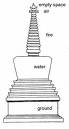
The earliest surviving religious structures are the Buddhist Stupas. The Stupa is a large burial mound, hemispherical in shape, with a central chamber in which a small casket containing the relics of the Buddha is preserved. The core of the mound was of unbrunt bricks, its outer face of burnt brick, and the entire structure was given a skin of thick plaster. On top of the hemisphere stood the harmika, a stylized umbrella of stone or wood. A fence-made first of wood but later replaced by stone-ran round the stupa enclosing a path for the ritual of circumambulation. Some of the stupas as at sanchi (2nd century B.C.E) were provided with beautiful entrance arches (torana) at the four cardinal points. Smaller stupas and monasteries and theological colleges gradually sprung around the main stupa converting the site into a colony of monks and learned men.

The biggest and best preserved is the Sanchi Stupa of Madhya Pradesh, stupas at Sarnath near Varanasi and Amaravati in Andhra Pradesh.
26 November 2006

Town Planning

Built as early as 3000 BC, the Indian town had quality materials of superior finish and high standard of manipulation, giving perfect stability to construction. Straight roads at right angles, main thoroughfares running almost north to south, east to west. It possessed a network of covered drainage that was new in the ancient world.

The reconstruction of Kusingar, of the 7th century BC, had horizontally placed cylindrical rooftops so designed as to permit free flow of air and light. No other city in the ancient world outside India had such a design incorporated.

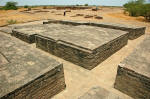
The Great Bath, built at Mohen-jo-daro is unique. The tank has a rectangular structure. It is situated in the center of a courtyard and measures 11.89 mts from north to south and 7.01 mts from east to west, the depth being 2.44 mts. A double ringed well in one of the rooms for supply of water to bath, the floor of which is approached by a flight of steps on the north and south.

An interesting feature of the construction was the care bestowed in water tightening of the structure. A 2 cms, thick damp-proof course of bitumen was used between the facing baked bricks of the basin and the intermediate wall, which inturn was retained by a mud-brick packing and the outermost baked-brick wall.

Across the lane to the north of the Great Bath there is a block with eight bathrooms arranged in two rows, one on either side of a drain. Each bathroom in Mohan-ja-daro had a staircase that was leading to the upper storey and privacy was secured by ensuring that the doors were not disposed opposite to one another.

18 October 2006

Taj Mahal

Taj Mahal, located on the banks of the Yamuna River is one of the Seven Wonders of the World. The Mughal Emperor Shahjahan as a memorial built this marble tomb for his wife, Mumtaz. A dream etched in milky white pristine marble is the peerless monument portraying the beauty of eternal love.


A commemoration of the memory of Shahjahan’s beloved wife, Taj Mahal is indeed India’s rich tribute to womanhood. The construction of the Taj commenced in 1631 and was completed in 1653. Workers were gathered from all over the country and from Central Asia. About 20,000 people were recruited to translate this wild dream into a reality. The main architect was Ustad Isa Khan, who was brought all the way from Shiraz in Iran. The walled complex includes two mosques and an imposing gateway. The tomb is encased in white marble that is decorated with flawless sculptures and inlaid design of flowers and calligraphy.

17 October 2006

Mysore Palace

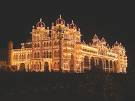
The Maharajah’s Palace is a magnificent three-storied structure with a five-storey tower, designed by the English architect Henry Irwin. The famous Mysore palace also known as the Amba Villas Palace is one of the largest palaces in the country. The palace was originally built of wood, which got burnt down in 1897 and was rebuilt in 1912. It is a healthy combination of Dravidian, Indo-Sarcenic, Oriental and Roman styles.


It is attractive both inside and outside. It’s a kaleidoscope of stained glass and mirrors. There are also beautifully carved wooden doors and mosaic floors. The tastefully decorated and intricately carved doors open into luxuriously decorated rooms. The ground floor with an enclosed courtyard display costumes, musical instruments, children’s toys and numerous portraits. The upper floor has a small collection of weapons. The carved mahogany ceilings, solid silver doors, white marble floors and columned Durbar hall are a feast to the eyes.

15 October 2006

The Dock At Lothal

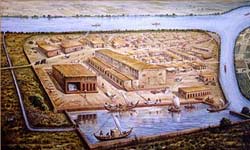
Lothal city was planned on similar lines as Hadappa and Mohen-jo-daro. The features of which are an orderly array of streets and lanes crossing one another at right-angels and the division of the town into various blocks, which distinguish Indus cities from Mesopotamian and Egyptian towns. Initially, Lothal dock was rectangular on plan measuring 300 mts from north to south and 400 mts from east to west, and was protected against floods by a 13 mts thick wall of mud bricks.

Artificial dock for berthing ships
Lothal city’s engineers made the greatest contributions to the advancement of science and technology by building an artificial dock for berthing ships.
The Lothal dock is noted for its unique water-locking device, introduced in the spill-way, which could be closed or kept open according to necessity. It regulated the flow of water a high tide and ensured flotation of ships at low tide without necessitating the basin to be silted up. The perfect verticality of the inner face of the walls enable ships to come right upto the edge of the wharf for loading and unloading. A trapezoid basin measuring an average 214 x 36 mts was excavated on the eastern flank of the city and closed by masonry walls of kiln-fired bricks, with necessary gaps for the inlet and spillway in the shorter arms on the north and south respectively.


This technology was applied for laying canal network, with intervening water holding tanks and sluice gates put in place to place to control the volume and direction of water flow.