Showing posts with label india. Show all posts

11 May 2007

The Meenakshi

The Meenakshi Temple of Madurai is a typical example of architectural excellence. It is actually a double temple, dedicated to Sundareshwarar (Siva) and his consort Meenakshi. The outer walls enclosing the shrines and other structures measure 259 mts x 221 mts and each of the four sides has a large gateway. The shrine which consists of the three famous compartments- cellar, vestibule and the assembly hall – is situated in the third and inner most enclosure, which has only one entrance on the east. The sanctum has a small tower rising above the flat roof of the other two compartments. All the courts and hall situated with the three enclosures have colonnades of pillars of pillars of bizarre designs. The most exquisitely wrought pillars belong to the covered court [Swami Singotnam) outside the entrance to the innermost enclosure. The figure-sculptures attched to some of the shafts are larger than life-size and of excellent workmanship.

To the south of the main sanctuary is the shrine dedicated to Meenakshi, the consort of the deity. Among the eleven gopurams in the temple, the largest and the best of them is the southern doorway rising to a total height of 61mts. The lofty base and the concave curves of the whole structure tend to give it a soaring quality greater than what its height suggests. The surface is pulsating mass of masonry, covered all over with plastic figures of deities and semi-divine characters freely drawn from the inexhaustible treasure-house of Hindu mythology.

Images of Meenakshi Temple

  1. Meenakshi temple, Madurai
  2. Inside Meenakshi temple
  3. Towers of Meenakshi Temple
  4. gopuram of Meenakshi Temple


03 February 2007

Brihadeeshwara Temple

The magnificent Brihadeeshwara temple is a symbol of the greatness of the Chola Empire under the emperor king Rajaraja Chola. One of the tallest temple in the world, it was so designed that the vimana never casts a shadow at noon at any time of the year.

Sama Varma, the chief architect began to design a structure, which stood on a square base of 29mts and rose up to a height of about 65 mts. The temple stands within a fort. The towering Vimanam is about 200 feet high. The octagonal Shikharam rests on a single block of granite weighing 81 tons. The size of the Nandi matches that of the huge Linga. The Kalasam on top is about 3.8mts in height.

The temple stands within a huge compound walls rising above 15 mts. Sama Varma crowned its glory with 12.5feet tall finial of 9.25kg of copper plated with 800gms of gold.

Another architectural wonder is seen in the tower with the huge dome. It is made of black granite and estimated to weigh 80tons. Besides, the gopuram on which this dome rests is 216feet high.

The lofty sanctum tower is enclosed by a rectangular corridor consisting of two squares. The main tower occupies the central part of the rear square. The central tower has 16 tiers up to its 200feet height. On the inner wall of the Garbha Griha or the sanctum sanctorum are sculpted 108 dance poses or karmas performed by Lord Shiva.

Images of Brihadeeshwara Temple
  1. Brihadeeshwara Temple
  2. Brihadeeshwara Temple
  3. Brihadeeshwara Temple
  4. Brihadeeshwara Temple


05 January 2007

Mahabalipuram

The group of monuments at Mahabalipuram consists of ten mandapas (pavilion) or excavated halls besides seven monolithic rathas (chariots), so called because they resemble the big temple cars in which the images of the deities are taken out in procession. The mandapas, which are no higher that 4.5 or 6 mts, are remarkable for the shape and design of their pillars and roll cornices and for the blending of figure-sculpture with architecture. The panels of sculpture enclosed within plasters and mouldings on the interior walls of Durga and Varaha mandapas represent the finest achievement of the Pallava style.

The Architecture of the monolithic rathas is based on the older Buddhist monasteries (viharas). They are square or oblong in plan and pyramidal in elevation, but varying in size and some minor details. The largest and the most complete of them is what is called the Dharmaraja Ratha, which combines all the features of the Pallava style-pillars in the portico with rampant lions, the pyramidal tower and the turreted roof. The Bhima, Ganesh and Sahadeva rathas are oblong in plan and are based on the architecture of the Buddhist Chaitaya hall. They are two or three storeys high, and are surmounted by a barrel roof with the Chaitaya gable at the ends.

The solidity of the masonry of the Shore Temple at Mahabalipuram is vouched for by the fact that for over 12 centuries it has withstood the pitiless onslaught of the monsoons, the battering of sea waves and the treachery of drifting sands.

Images Of Mahabalipuram

  1. Mahabalipuram-Seashore Temple
  2. Pic from Mahabalipuram[right]
  3. Around Mahabalipuram
  4. Mandapas Mahabalipuram[right]


06 December 2006

Agra Fort

Located on the banks of the Yamuna, 2 kms northwest of the Taj Mahal, the fort was designed and the built by Akbar in 1565 A.D. The fort houses the beautiful Pearl Mosque and numerous places including the Jahangir Mahal, Diwan-i-Khas, and Diwan-i-Am.

The high red sandstone ramparts of this great monument stretch for almost 2.5 kms, dominating a bend in the river Yamuna. Emperor Akbar laid the foundation of this majestic citadel and it developed as a stronghold of the Mughal Empire under successive generations. Shahjahan constructed the graceful Diwan-i-Am or the Hall of Public Audiences in 1628.


Three rows of white polished stucco pillars topped by peacock arches support the flat roof. Today, this hall is bereft of brocade decorations, silk carpets and satin canopies that would have enhanced the elegance of the setting when the Emperor sat down with his subjects for discussions.
Images Of Agra Fort
  1. Agra Fort
  2. Jahangir Mahal[right]
  3. Diwan-i-Khas
  4. Sun From Fort[right]

03 December 2006

Ajinkya's Blog Disclaimer

"We, the bloggers of the World Wide Web, in order to facilitate the transfer of information online, ensure our voices are heard, provide accurate news and opinionated perspective in the face of an increasingly defunct and exempt media, and to poke fun at our culture's inane obsession with liability, do abide by, adhere to and generally follow Herche’s Blog Disclaimer."
ARTICLE I: TERMS OF ACCEPTANCE
By accessing this website, a web browser (user) is familiar with and accepts the following disclaimer.
ARTICLE 2: TERMS OF USE
Section 1
Clause 1: The views expressed by the contributor(s) on this site do not necessarily reflect the views of this site, the views of those who link to this site, the views of this site’s web host, template designer, or any other organization, service, logo, insignia or avatar in any way connected with this site.
Clause 2: The views expressed by a contributor(s) on this site may or may not be the views of the author.
Clause 3: Comments on this site are the sole responsibility of their writers and the accuracy and completeness of comment content is not guaranteed.
Clause 4: All trademarks, service marks, collective marks, design rights, personality rights, copyrights or registered names used or cited by this site are the property of their respective owners.
Section 2
Clause 1: This site does not offer legal, medical, physiatric, veterinary or any other kind of professional advice. Nothing on this site should be construed as professional advice.
Clause 2: The information provided herein is of a general nature and cannot substitute for the advice of a licensed professional. A competent authority with specialized knowledge is the only one who can apply it to the circumstances of your case.
Clause 3: Please contact the local bar association, law society, neighborhood association of jurists, medical board, county hospital, phone book, online directory, Google or local emergency number in your jurisdiction to obtain a referral to a competent professional if you do not have other means of contacting an attorney-at-law, lawyer, civil law notary, barrister, solicitor, medical professional, coroner or any other professional
ARTICLE 3: LINK POLICY
Clause 1: This site has no control over the information you access via outbound link(s) in the post text, sidebar, header, footer or comment sections.
Clause 2: This site does not endorse linked site(s), cannot guarantee the accuracy of any information found on said sites or the correctness of any analysis found therein and should not be held responsible for it or the consequences of a user’s use of that information.
Clause 3: This site may inadvertently link to content that is obscene, prurient, useless, hate speech or pornographic. This site in no way condones, endorses or takes responsibility for such content.
ARTICLE 4: PUBLICATION
Section 1
Clause 1: Publication of information found on this site may be in violation of the laws of the country or jurisdiction from where you are viewing this site’s content.
Clause 2: This site publishes content and is maintained in reference to the protections afforded it under local, state, provincial, international and federal law.
Clause 3: Laws in your jurisdiction may not protect or allow the same kinds of speech or distribution.
Clause 4: This site does not encourage, condone, facilitate or protect the violation of any laws and cannot be responsible for any violations of such laws.
Section 2
Clause 1: Because the World Wide Web is an integrated net of communication, this site encourages the distribution of its content. Cross, reciprocal or just plain friendly hyper linking is consistent with this information sharing and this disclaimer should not be construed as a condemnation of said practices.
Clause 2: Any reproduction of this site’s content must credit the site by name and Uniform Resource Locator (URL).
Clause 3: Should you link to this domain or use, reproduce, or republish the information contained herein, you alone are responsible for that action.
.
.
.

02 December 2006

Stupas

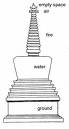
The earliest surviving religious structures are the Buddhist Stupas. The Stupa is a large burial mound, hemispherical in shape, with a central chamber in which a small casket containing the relics of the Buddha is preserved. The core of the mound was of unbrunt bricks, its outer face of burnt brick, and the entire structure was given a skin of thick plaster. On top of the hemisphere stood the harmika, a stylized umbrella of stone or wood. A fence-made first of wood but later replaced by stone-ran round the stupa enclosing a path for the ritual of circumambulation. Some of the stupas as at sanchi (2nd century B.C.E) were provided with beautiful entrance arches (torana) at the four cardinal points. Smaller stupas and monasteries and theological colleges gradually sprung around the main stupa converting the site into a colony of monks and learned men.

The biggest and best preserved is the Sanchi Stupa of Madhya Pradesh, stupas at Sarnath near Varanasi and Amaravati in Andhra Pradesh.
26 November 2006

Town Planning

Built as early as 3000 BC, the Indian town had quality materials of superior finish and high standard of manipulation, giving perfect stability to construction. Straight roads at right angles, main thoroughfares running almost north to south, east to west. It possessed a network of covered drainage that was new in the ancient world.

The reconstruction of Kusingar, of the 7th century BC, had horizontally placed cylindrical rooftops so designed as to permit free flow of air and light. No other city in the ancient world outside India had such a design incorporated.

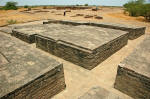
The Great Bath, built at Mohen-jo-daro is unique. The tank has a rectangular structure. It is situated in the center of a courtyard and measures 11.89 mts from north to south and 7.01 mts from east to west, the depth being 2.44 mts. A double ringed well in one of the rooms for supply of water to bath, the floor of which is approached by a flight of steps on the north and south.

An interesting feature of the construction was the care bestowed in water tightening of the structure. A 2 cms, thick damp-proof course of bitumen was used between the facing baked bricks of the basin and the intermediate wall, which inturn was retained by a mud-brick packing and the outermost baked-brick wall.

Across the lane to the north of the Great Bath there is a block with eight bathrooms arranged in two rows, one on either side of a drain. Each bathroom in Mohan-ja-daro had a staircase that was leading to the upper storey and privacy was secured by ensuring that the doors were not disposed opposite to one another.

18 October 2006

Taj Mahal

Taj Mahal, located on the banks of the Yamuna River is one of the Seven Wonders of the World. The Mughal Emperor Shahjahan as a memorial built this marble tomb for his wife, Mumtaz. A dream etched in milky white pristine marble is the peerless monument portraying the beauty of eternal love.


A commemoration of the memory of Shahjahan’s beloved wife, Taj Mahal is indeed India’s rich tribute to womanhood. The construction of the Taj commenced in 1631 and was completed in 1653. Workers were gathered from all over the country and from Central Asia. About 20,000 people were recruited to translate this wild dream into a reality. The main architect was Ustad Isa Khan, who was brought all the way from Shiraz in Iran. The walled complex includes two mosques and an imposing gateway. The tomb is encased in white marble that is decorated with flawless sculptures and inlaid design of flowers and calligraphy.

17 October 2006

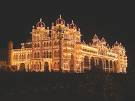
Mysore Palace

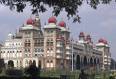
The Maharajah’s Palace is a magnificent three-storied structure with a five-storey tower, designed by the English architect Henry Irwin. The famous Mysore palace also known as the Amba Villas Palace is one of the largest palaces in the country. The palace was originally built of wood, which got burnt down in 1897 and was rebuilt in 1912. It is a healthy combination of Dravidian, Indo-Sarcenic, Oriental and Roman styles.


It is attractive both inside and outside. It’s a kaleidoscope of stained glass and mirrors. There are also beautifully carved wooden doors and mosaic floors. The tastefully decorated and intricately carved doors open into luxuriously decorated rooms. The ground floor with an enclosed courtyard display costumes, musical instruments, children’s toys and numerous portraits. The upper floor has a small collection of weapons. The carved mahogany ceilings, solid silver doors, white marble floors and columned Durbar hall are a feast to the eyes.

15 October 2006

The Dock At Lothal

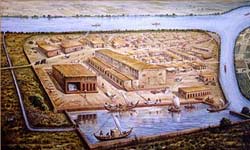
Lothal city was planned on similar lines as Hadappa and Mohen-jo-daro. The features of which are an orderly array of streets and lanes crossing one another at right-angels and the division of the town into various blocks, which distinguish Indus cities from Mesopotamian and Egyptian towns. Initially, Lothal dock was rectangular on plan measuring 300 mts from north to south and 400 mts from east to west, and was protected against floods by a 13 mts thick wall of mud bricks.

Artificial dock for berthing ships
Lothal city’s engineers made the greatest contributions to the advancement of science and technology by building an artificial dock for berthing ships.
The Lothal dock is noted for its unique water-locking device, introduced in the spill-way, which could be closed or kept open according to necessity. It regulated the flow of water a high tide and ensured flotation of ships at low tide without necessitating the basin to be silted up. The perfect verticality of the inner face of the walls enable ships to come right upto the edge of the wharf for loading and unloading. A trapezoid basin measuring an average 214 x 36 mts was excavated on the eastern flank of the city and closed by masonry walls of kiln-fired bricks, with necessary gaps for the inlet and spillway in the shorter arms on the north and south respectively.


This technology was applied for laying canal network, with intervening water holding tanks and sluice gates put in place to place to control the volume and direction of water flow.

08 October 2006

Rock Cut Culture

No other country has so accurately recorded the carpenter’s craft as practised 2,000 years ago.

Chaitanya Hall at Karla, Maharashtra 1st century BC has a cylindrical vault. Hewn out of a single rock are the details of the joinery and rock-cut columns .It is an apsidal hall excavated into solid rock with rows of pillars running along the walls that supports a curved roof, resting on ribs in imitation of the barrel vaulting of a wooden structure. Most notable development in rock-architecture happened during the period from the seventh to the 10th centuries. The entire Kailas temple at Ellora, Maharashtra (6th Century AD), is the largest single piece of sculpture in the world. Worked from the top to the ground level, this temple complex occupies twice the plinth area of the Parthenon in Greece. Indian craftsmen had mastered the technique of transferring the load from top into the earth by balancing it through the application of poise, counterpoise and load bearing crossbeams.

23 September 2006

Dronacharya Awards and Arjuna Awards

Dronacharya Awards and Arjuna Awards

  • Dronacharya Awards was instituted in 1985 to honour eminent coaches, who have outstandingly and consistently motivated sportspersons to the highest performance in international events.
  • Arjuna Awards was institutd in 196 as the highest national recognition for outstanding performance in sports and games at the international level.

Bravery and Gallantry Awards

Bravery and Gallantry Awards
National Bravery Awards was started in 1957 by the Indian Council for child Welfare. The award was to recognize and honour children who performed outstanding deeds of bravery and selfless sacrifice.

Gallantry Awards The Ashok Chakra series of awards are open to civilians. These awards are biannual and are given on the Republic Day and Independence Day.


28 August 2006

Bharat Ratna and Padma Awards

Padma Awards :
Padma Awards namely, Padma Vibhushan, Padma Bhushan andPadma Shree are given for exeptional and distinguished service of high order in any field. The Padma Awards are announced on the eve of the Republic Day.
>>>>>>>>>>>Padma award

BHARAT RATNA AWARDS
The President of India gives the BHARAT RATNA AWARDS , the highest civilian honour, for exceptional service towards advancement of Art, Literature and Science, and in recognition of Publoc Service of the highest order.
Bharat ratna awards<<<<<<<<<<<
Thanks to chyk.
FROM THE BOOK: AWAKENING INDIANS TO INDIA
http://www.chinmayamission.com/

Awards & Honours

Introduction

India, as we have stated throughout this book, is a lead of excellence. Our countrymen have been excptional achievers in various fields of activity, which ranges from sports and gallantry to arts nad science.

And our country employs a number of awards to honours these great men and women of our country, whose actions and deeds have made us proud and glad. These awards play an important role in our life, as they prove to be not only a source of encouragement for the extra-ordinary, but also an inspiration for the ordinary.

20 August 2006

True Indian Game

National Game


Hockey is the Notional Game of India. Unmatched excellence and incomparable virtuosity brought India a string of Olympic gold medals. The brilliant Indians brought a touch of magic to their play and the ball-juggling feats of the Indians were a sheer delight. The Golden Era of hockey in India was the period form 1928-1956 when India won 6 consecutive gold medals in the Olympics. During the Golden Era, India played 24 Olympic matches, won all 24, scored178 goals (at an average of 7.43 goals per match) and conceeded only 7goals. The two other gold medals for India came in the 1964 Tokyo Olympics and the 1980Moscow Olympics.

29 June 2006

National Fruit

A fleshy fruit, eaten ripe or used green for pickles etc., of the tree Magnifera indica, the mango is one of the most important and widely cultivated fruits of the tropical world. Its juicy fruit is a rich source of Vitamins A, C and D. In India there are over 100 varieties of mangoes, in different sizes, shapes and colours. Mangoes have been cultivated in India from time immemorial. Poet Kalidasa sung its praises and Akber planted 100,000 mango trees in Darbhanga, known as LAKHI BAGH.

MANGO FRUIT(Y)……….. FRESH ‘N’ JUICY


Thanks to CHYKRef:
Awakening Indians To India
http://www.chinmayamission.com/

20 June 2006

National Animal

Tiger the magnificent animal is scientifically called the Panthera Tigris (Linnaeus), the national animal of India, is a rich-coloured well-striped animal with a short coat. The combination of grace, strength agility and enormous power has earned the tiger great respect and high esteem. Out of the eight races of the species known, the Indian race, the Royal Bengal Tiger is found throughout the country (except the north-western region) and also in neighboring countries like Nepal, Bhutan and Bangladesh. To check the dwindling population of tigers in India, which came down to just 1,827 in1971, ‘Project Tiger’ was launched in April 1973.

Since then, the tiger population has shown a gradual increase and the census of 1993 puts the tiger population of the country at 3,750. So far, 23 tiger reserve have been establish in the country under this project, covering an area of 33,406 sqkm.

The tiger needs to be emulated to remain alert & swift while working towards our goals in life.


Wah! Kya sher hai!!!

Dynamic India
Thanks to chyk.
FROM THE BOOK: AWAKENING INDIANS TO INDIA

http://www.chinmayamission.com/

11 June 2006

National Bird

The Indian Peacock, Pavo cristatus (Linnaeus), the national bird of India, is a colourful, swan-sized bird with a fan-shaped crest of the feathers on its head, a white patch under the eye and a spectacular bronze-green tail of around 200 elongated feathers. The female is brownish, slightly smaller than the male and lacks the tail. The elaborate courtship dance of the male by fanning out the tail and quivering the feathers is a gorgeous sight.


The peacock is widely found in the Indian sub-continent from the south and east of the Indus river, Jammu and Kashmir, East Assam, South Mizoram and the whole of the Indian peninsula.
The peacock enjoys full protection under the Indian Wildlife (Protection) Act, 1972.


The Mayuri ….Our Story
Peacock represents a colourful life.
Thanks to CHYK
Ref: Awakening Indians To India
www.chinmayamission.com

02 June 2006

National Tree

Commanding a central presence in the timeless setting of India’s countryside, is the mighty Banyan, a tree endemic to the Indian subcontinent. For man it provides shelter and is a point where the village community gathers and transacts much of their affairs.
The tree is a veritable microhabitat for countless creatures. It releases maximum ozone in the atmosphere. Like the Banyan, India shelters all races, castes, creed and religion. To them all, it gives wisdom.


Thanks to CHYK.
Ref: Awakening Indians To India.
http://www.chinmayamission.com